Showing posts with label Materials. Show all posts

Friday, 31 May 2013

Last Few Weeks

There are only a few weeks left until this project is finally over. There are a few developments, a few set backs and just general work needing to be done. 
Here is some more stuff. I've been jumping back and forth for the final designs in thermo/acrylic paint. The categories i've narrowed the ideas into include: photo, abstract, metaphor, icon and pattern. 
As the pigments of the thermo-dyes are powdered I went to the local art shop North Shore Art Supplies and bought a $30 bottle of clear medium to mix it. Hope it works well. As i still dont have the dye, and probably wont until the 13th, ive been working on how to display and make the prototype. The local $2shop is having a 40% off sale (YAY), so im going to run up to grab some large frames. On sunday im in the city helping a friend with prop design, so ill run up to Recycled Garbage too and find something great to print/paint on. Im having difficulty deciding what to print on as it needs to be heat proof and also be able to be touched repeatedly without getting ruined. So some solutions include:
- printed paper/board/card with a plastic overlay
- printed paper/board/card with a glass overlay (frame)
- printed plastic/glass

The heating element has been a bit of a head-scratcher. I was torn between using arduino to control it, but ended up ripping up an electric heating sheet. Which was not fun. Also - RE-USE!
This Sunbeam Electric Blanket was made in New Zealand with 100% Polyester. Its 250volts~1amp~100watts. The PVC plastic used in the wiring & control components is a polyvinyl chloride plastic which is used in everything from pipes, shower curtains, plastic outdoor furniture and childrens' toys. It can be recycled and re-used however it takes a crapload of time and effort to reduce it down and have it degrade. I did have to test is, as i didnt know if it still worked. It does. And heats up so damn quick.

The next couple things I need to do (start, end, middle):
- Designs & individual names
- Name the series
- Visual Identity
- Final product (life cycle analysis - materials & processes)
- Postcard type material to reflect important info for presentation
- Render vids/pics
- Timelapse vid (borrowing a friends' camera and expertise...bribe with candy)
- Possible shopping website 
- Presentation visuals(pdf) & general speeching things


Friday, 24 May 2013

Countdown!

Last month until 30min presentations are due. 
I just bought the pigments to make thermo-paint. Itll take about 3weeks. From the states. To Sydney. Crap. After some research, relying mostly on the accounts from these two lovely sites: softcircuit2 & artisticjunkie, I've purchased the "dust" from solarcolordust and need to go buy a Liquitex Slow-Dri Fluid Retarder Additive from my local-has-everything-ever-imagined-artshop North Shore Art. For the presentation i'll also need to get a heating pad to put behind the displays in-order for the designs to change. 

Inspiration:

Face 37 - September Poster 

"September is typically regarded as a month of transition in the Northern Hemisphere as the dying embers of Summer are replaced by the cooler and greyer chills of Autumn and the onset of early darkness. It is often associated with melancholic self-reflection as if heat and sunlight are a temporary physical and mental panacea. inspired by the physical reality of changing seasons and simple emblematic change of colour of falling leaves, I used thermochromic ink that alters colour dependent on room temperature."
You can purchase it here: face37

Another Example: Im not sure of the name, or who created the design but it can be found here: miafranceskennedy.

This is just damn great. Again, no idea who created it. Has nothing to do with thermoes but its could be applied.


Sunday, 12 May 2013

Advertising and Movie-making

Coopers "Light After Dark" campaign launched a "handcrafted" luminous UV painted billboard.


Another great use of the glowy paint was in the construction and design of Lord of the Rings' scale models of Minas Morgul.

Saturday, 11 May 2013

Photochromic & Thermochromatics

So the last couple ideas were not working out. They were catering towards the tutors' specialties and not necessarily as a combination of my majors: Graphics Media and Environmental/Spatial Design. I wasn't however processing the feedback correctly, even if Richard's was "make it". 

Now. I've been looking at lights:
Anthony McCall, "Five Minutes of Pure Sculpture" & United Visual Artists, "Vanishing Points"
Other things:
Jody Xiong, "Green Sidewalk Campaign" & Adam Niklewicz, "The Charter Oak"
And Brad, in our thursday class, discussed going back to graphics in the environment using UV paint that reacts to blue light. Tunnel vision had set in and I hadn't analysed my process from an outside perspective. I had become to accustomed to Katherine Moline's graphics class, where sets of tables or the entire class would go round to each persons' work and give feedback. Now there are too many students per class, and not enough time to talk with tutors. That and my own tunnel vision. 

Now that all this has been understood, I am adjusting my thinking back to graphics-y things (so i can still use a bunch of research including info-graphics!). Photochromic inks change colour when exposed to ultraviolet light from the sun or a black light. Examples: 
Clothing: Printed shirt alters colour in the sun.
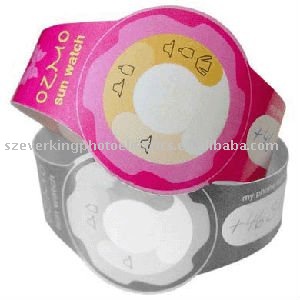
Health: "Sun Watch" changes colour and illustrate needs when exposed to the sun.
Structure: Christoph Klemmt's award winning Or2 Photochromic Canopy Structure.
Paper: Advertising for skin cancer.

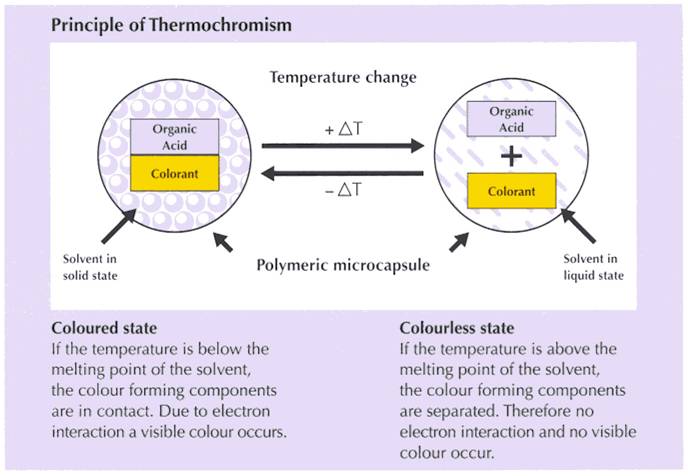
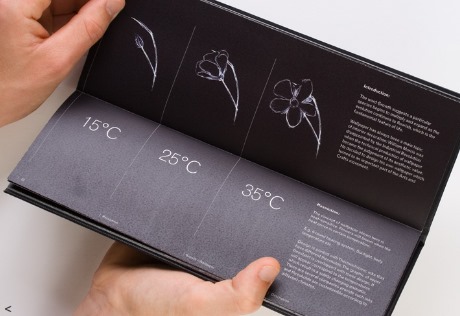
Which then brought me to Thermochromatic Ink. Instead of light affecting the chemical structure, this relies on temperature.
Architerials has a great look at Thermochromatics and its use.

Film: 
Polyester:


Click on pics to go the links and information.


Friday, 12 April 2013

Real Quick Research

Weather Project, Olafur Eliasson, 2003
His site: olafureliasson
His pictures/video:

What a badass: "I'm just gonna put a sun in a room." (Please note that this was, to my knowledge, never said by Eliasson).

Nimbus, Berndnaut Smilde, 2010-2013

Site: berndnaut
Pics/Video:


More weather! In a smaller room!

Caleb Charland

Site: calebcharland
Stuff:
That is a lamp powered by apples. 
And a lamp powered by potatoes.
And citrus.

I didn't know how one would go about making a food powered lamp. I must have skipped that lession in year seven, however I did attend the week we were supposed to memorise the first 20 elements of the periodic table for a test. Hydrogen, Helium, Lithium, Beryllium....So I looked it up and thanks to Physlink I kinda understand the theory behind it:

Essentially "zinc and the copper are the anode and cathode terminals of your potato batter. Using ordinary hook-up electrical wire, you can use the potato to create a voltaic cell, which will power a VERY small bulb. A light emitting diode (LED) will work fine.

Cut the potato in half. Wrap the end of a piece of wire around a galvanised nail and wrap the end of a second piece of wire around a penny. Stick the copper side into one piece of potato the nail into the other. The zino and copper electrodes should not touch each other. If a wire is connected between the zinc nail and the copper penny, electrons will flow. However, direct contact of the two electrodes will only produce heat."

And then it goes into the chemical reactions which makes it happen. Link: physlink
This guy is a gun when it comes to explaining this:


And these guys are british:


Thursday, 11 April 2013

Sketching, Writing, Mapping etc.

These are a bunch of dodgy sketches from last(ish) week. They were were tailored towards the in-home responsive walls or installation piece. Though a lot focus on texture.


Today, thursday, big day, Brad Miller and I discussed the 'object' idea. I would like to reiterate the point that I HAVE NEVER TAKEN AN OBJECT COURSE! Ive been working with either 2D graphics or GIANT scale environment/spatial design over the COFA course. I believe that a different style of thinking is needed that I dont altogether possess so much. SO its going to be interesting. Brad briefly mentioned the techno-walls I was investigating in the early weeks. The entire project cycle has circled! But I do like the product design idea...a lot....so it could theoretically a possibility in future...

BACK TO MINDMAPPING
But you probably can't read that. Nor should you want to. I can barely understand it.
Generally I went back over concept, function, and metaphor. They are still very much the same: create an atmosphere invoking work [now an object] that provides students a tangible example of their energy usage. I need to figure out now:
A. Technical aspect of measuring electricity emitted in the room;
B. Mechanism to make the object pulse/expand/invade;
C. Energy the object itself requires;
D. More information on students' energy use and their attitudes towards it;
E. FORM: this is a big one because then it develops more info (materials, OHS, scale, place, metaphor, atmosphere). 
[I should note that Richard Goodwin suggested reversing the idea whereby energy use would develop a repulsive aesthetic and energy saving would provide a "beautiful" style. I however did not think it would be as interesting as a space being suffocated by swelling surfaces to choke the area and disable use of electrical outlets/products.]

And yes, the cut of writing at the bottom right is "AAAAAAAHHHHHHHHHHHHHH"

I did some more research alongside this mind exploding re-direction. However I did not put them up. They will be possibly tomorrow. Possibly.
- Christo: Big Air Package;
- Martin Azua: Basic House;
- Berndnaut Smilde: Indoor Cloud;
- Jeff Coons: Balloon Animal Sculptures;
- Gehry: Cloud Lamp;
- Alex Schweder: Inflatable Room;
- Caleb Charland: Light (Powered by Apples).

Thursday, 28 March 2013

Anish Kapoor

Everyone at the moment is going on about Anish Kapoor. Everyone. He's exhibiting at the MCA in Sydney, Circular Quay and for the low low price of $20 you can fall into the rabbit hole and have a squiz into his crazy mind. He's a total bad-ass when it comes to material experimentation and creates weird, abstract, atmospheric sculptures? I question the term sculptures, just because if you see his stuff, it feels more live environment-creation or spatial-manipulation or whatever. 

You can find the link here: anishkapoor


Seriously! Who comes up with this? What kind of thinking creates this? Is Lewis Carroll hanging around? Is his literary nonesense jumping all around the MCA? 
I don't understand this kind of creation, but you don't really need to do you? Its all about experience right? So why the post?

My project has developed, as one should hope, and at the moment its looking more like an installation piece... not really accommodating for student housing. So really im working outside of constraints which is pretty much the wrong thing to do. In the presentations Brad Miller was talking about my client base - which I dont have. I thought about creating one. But i'm not really designing for a client. I have an end user - but im totally disregarding them. Maybe i should adjust the end user? Or should i utilise a client eg an exhibition space coordinator? Brad Miller suggested that i'm fighting against the restraints of projects in previous years. 

Back to the concept - a visual in my mind kinda feels like Anish Kapoors' style. At the moment I'm thinking of pulsing walls and parts of walls that become organic shapes and press in on the space. So I just looked up pictures of tumours and frog eggs to try and give a wee insight into what im going on about. That...well that was the wrong move. Don't do that. Ever. 


I've tried finding pics that would illustrate what im going on about but here is the best I can come up with (mostly because my illustrations are just...shocking. Gonna model it soon in CAD and hopefully that will go better). What im thinking is a combination of:

 + +

Well, maybe not Elmo. That thing is creepy though. And shakes. But mostly is creepy. Probably could have just stuck up picture of a ringing phone. Seriously, dont look up tumours. Or frog eggs.