Showing posts with label Product. Show all posts

Friday, 31 May 2013

Last Few Weeks

There are only a few weeks left until this project is finally over. There are a few developments, a few set backs and just general work needing to be done. 
Here is some more stuff. I've been jumping back and forth for the final designs in thermo/acrylic paint. The categories i've narrowed the ideas into include: photo, abstract, metaphor, icon and pattern. 
As the pigments of the thermo-dyes are powdered I went to the local art shop North Shore Art Supplies and bought a $30 bottle of clear medium to mix it. Hope it works well. As i still dont have the dye, and probably wont until the 13th, ive been working on how to display and make the prototype. The local $2shop is having a 40% off sale (YAY), so im going to run up to grab some large frames. On sunday im in the city helping a friend with prop design, so ill run up to Recycled Garbage too and find something great to print/paint on. Im having difficulty deciding what to print on as it needs to be heat proof and also be able to be touched repeatedly without getting ruined. So some solutions include:
- printed paper/board/card with a plastic overlay
- printed paper/board/card with a glass overlay (frame)
- printed plastic/glass

The heating element has been a bit of a head-scratcher. I was torn between using arduino to control it, but ended up ripping up an electric heating sheet. Which was not fun. Also - RE-USE!
This Sunbeam Electric Blanket was made in New Zealand with 100% Polyester. Its 250volts~1amp~100watts. The PVC plastic used in the wiring & control components is a polyvinyl chloride plastic which is used in everything from pipes, shower curtains, plastic outdoor furniture and childrens' toys. It can be recycled and re-used however it takes a crapload of time and effort to reduce it down and have it degrade. I did have to test is, as i didnt know if it still worked. It does. And heats up so damn quick.

The next couple things I need to do (start, end, middle):
- Designs & individual names
- Name the series
- Visual Identity
- Final product (life cycle analysis - materials & processes)
- Postcard type material to reflect important info for presentation
- Render vids/pics
- Timelapse vid (borrowing a friends' camera and expertise...bribe with candy)
- Possible shopping website 
- Presentation visuals(pdf) & general speeching things


Friday, 24 May 2013

What to do...

At COFA they encourage you to draw. Everything. I dont. I put everything on my mac. It just works better for me. Text, info, experiments, materials, inspiration etc. This is some of it.

Now I finally feel like the project is actually a thing. SO MUCH TO DO. Won't be sleeping for a while. Until the paints arrive I have a bunch to do:
WAITING:
- create the designs (as well as the colours/variations)
- borrow more screens for screen printing these designs (and clean them all off)
- expose and prepare the screens (it used to be $8 a screen for emulsion...not sure now)
- figure out what to print on (and also purchase/steal/commandeer these materials)
- figure out how to frame, hang, situate etc display (and also purchase/steal/commandeer these materials)
ARRIVED:
- paint like a ninja

- video time-lapse (borrow friends' camera...which the HD turbo charged greatness)
- edit said video (maybe an advert?)


SECONDARIES:
- re-name "I'd Tap That" to a lame, obvious, explanatory, descriptive name
- visual identity
- website
- product manual (life cycle analysis, use, info)
- packaging 
- presentation, speech, powerpoint, look-book

- 3D render the student accommodation and emulate the display in situ (aftereffect that up)


What has been repeated is that this project is supposed to be a read-to-sell prototype. So more things I must investigate:
- a "real" way to make and affect the heating elements (to alter designs)
- a "real" effective material that would withstand the displays being touched and used
- life cycle analysis


Saturday, 11 May 2013

Open Brain Storming

After researching photochromic and thermochromatic paints and their uses I've been thinking about the final presentation...Not long now. And I want to present something other than printed materials. I came across these handmade wall decals on facebook a while back. Just a bit of corn starch or a pre-made stick and boom instant wall art or wallpaper.
pistachioproject, sewingforscarlett & curbly have some good tutorials. 

While I wouldnt be allowed to paint a wall at cofa, perhaps I could stick it on and peel it off.
Crazy walls crazy walls crazy walls

Photochromatic Stuff
The museum goudA redesigned their torture chamber using UV. Illustration - Jos Verwer, and Type - Trapped in Suburbia

Internal Philips Design Metamorphosis document. The bookcover uses photochromic and thermochromic ink. 
Calignosity by Andreas Pohancenik - UV Varnish and invisible UV ink screen print on ebony plike, A1


Saturday, 4 May 2013

Whoops

The last post was a bit of an overreaction. A massive overreaction. The kind of reaction you get when you put a mentos into a coke bottle. Turns out I had Richard and Karina. And I scared the crap out of them with my research and enthusiasm. I was feeling a little lack-luster after so I took a day and jumped onto evolo and found some random inspiration. 


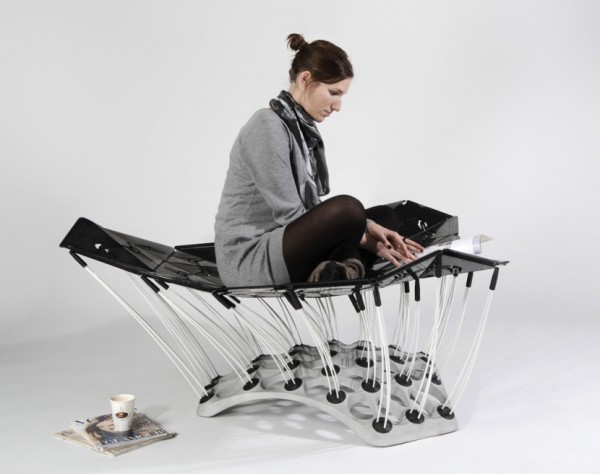
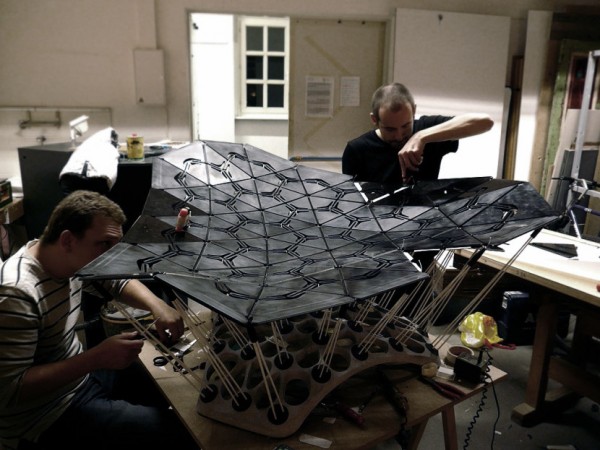
ChairBedStool
Design & Construction by Thoman Hiemann and Markus Dilger
Creates in the project group ID5, UdK Berlin with Prof. Burkhard Schmitz (no relation) and Katina Sostmann. 
I think, from the evolo page, that it was about "permanent adaption of the surface to the human body." By itself, the object looks like a reincarnated medieval torture device, due to its plastic clusters and elastic rods and geometric patterning and rigid segments and whatnot. BUT IT IS FREAKING AWESOME. It reacts to body movement and alters perceptions (or at least my perceptions) of static or stationary furniture. 
Im not entirely sure why this project is so interesting. Its a bit star-trekky. I want to see it in a long expansive structure. Adult trampoline.


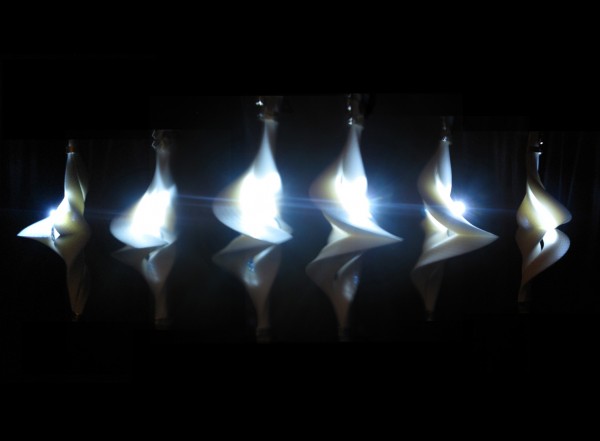
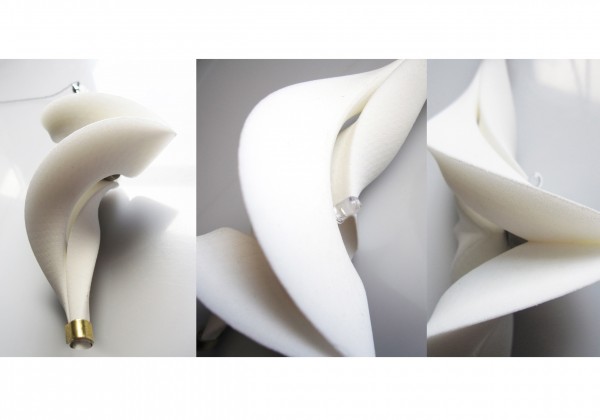
Designed by Dr. Margot Krasojević, the 3D printed nylon polymer lamp is suspended by a spindle. Its weight and form dictate the momentum as it spins which is affected by minor environmental change eg temp and current, all which change light patterns. Then there are some rather interesting words which talk about technology and physics. What I can decipher is that the light has been influenced by the physics behind ice skaters and spinning tops.
I think they are so interesting due to their convergence over a number of disciplines. To me they could represent energy efficiency, organic structure systems, dance, sea life, new forms of technologies, the combination of physics and design for interiors, art, etc etc. Maybe its ambiguity is what is intriguing to me. Without information on the product and no real conventions to rely on, its hardly a known object. Yep. It could be anything. I like that idea most of all.


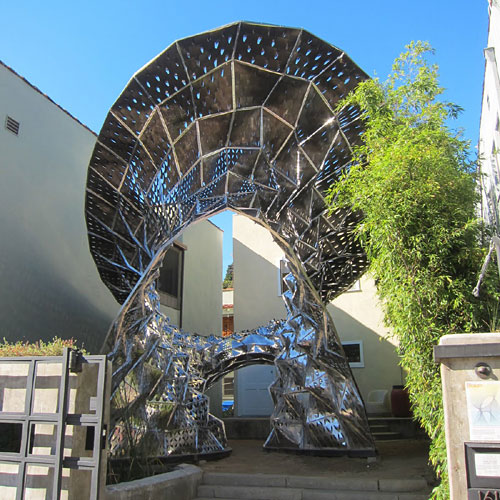
USC architect Prof. Doris Kim Sung design this "Bloom" installation made of 14,000 pieces of thermobimetal. That is, two thin sheets of metal with different expansion rates laminated together. The metal reacts to temperature with a direct correlation to the sun. I dont find the structure nearly as impressive as the technology itself. Metal that moves. Paradox!


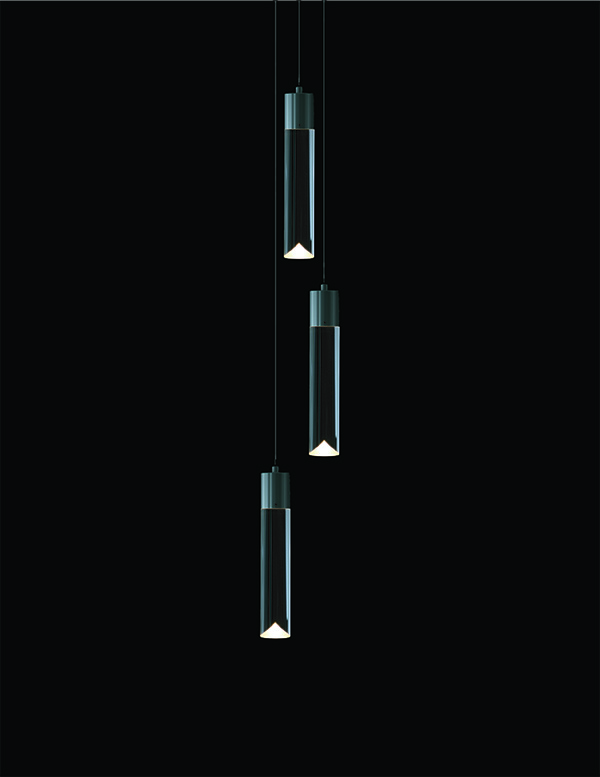
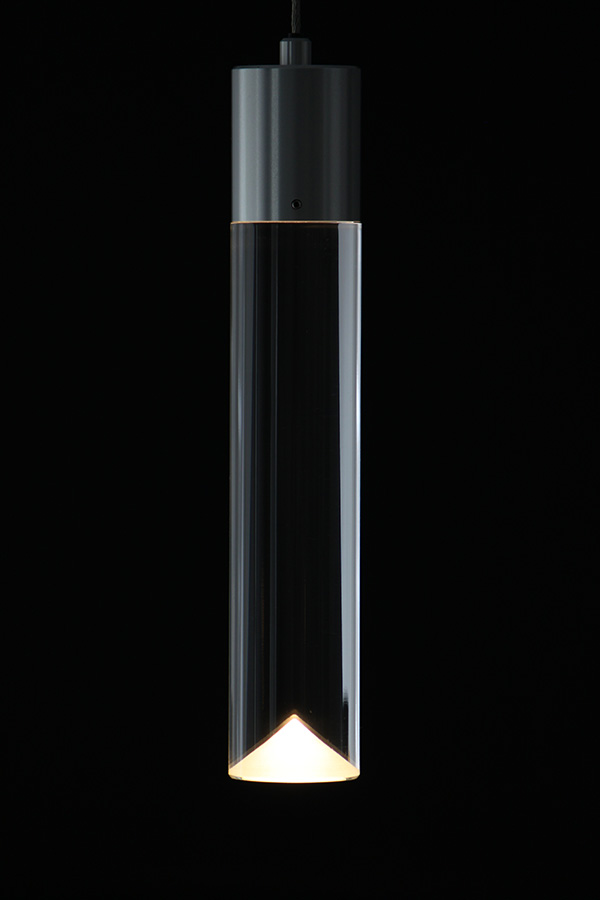
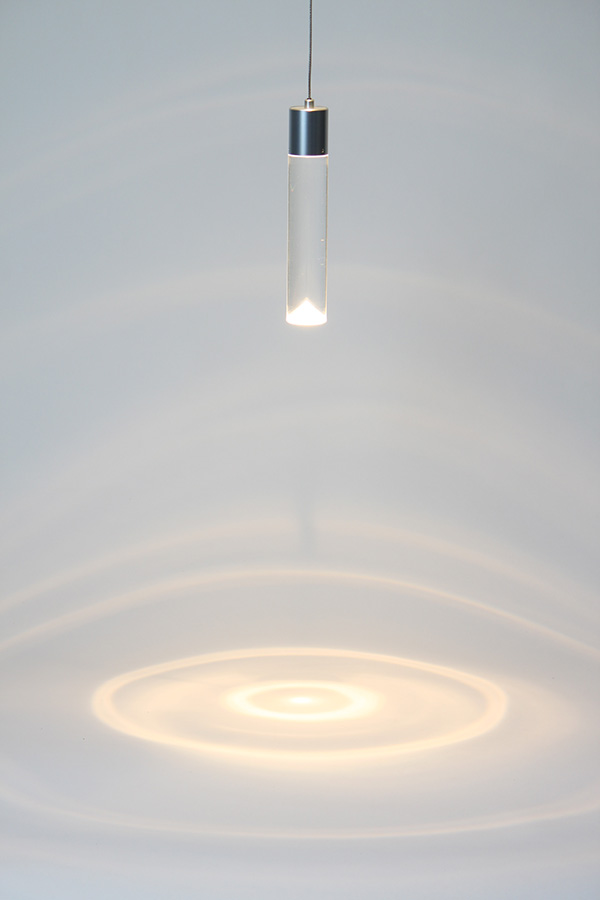
Saleem Khattak designed this energy efficient LED lighting, a luminaire that evokes the best qualities of incandescent lights: warmth, comfort and intimacy. Diffusers and cylindrical casing stops the glare from a visible light source. This is a perfect example of subtle complexity pwning overtly complex systems. I WANT ONE. Or a bunch. Put me down for a bunch. They have invert candle like qualities, in LED form.


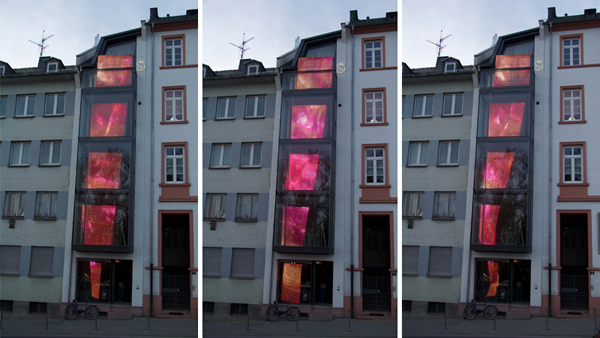
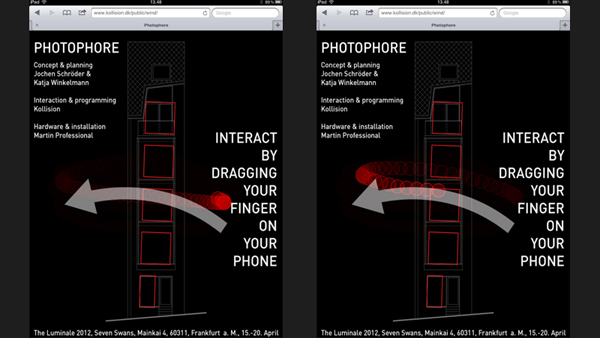
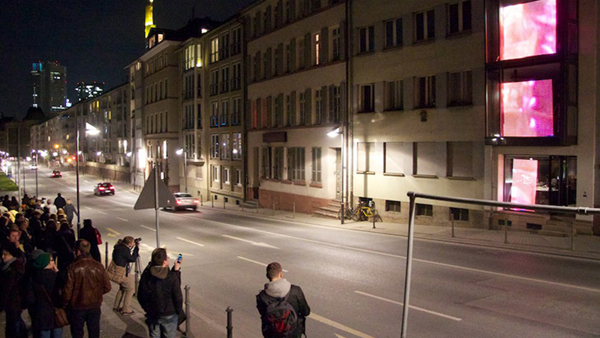
A 3D responsive veil operated by a smart phone. Designed for the Luminale 2012 in Germany, Kollision installation is a 5 story veil of light. People are able to scan those stupid QR codes into their phones and swipe the installation to the side. Jochen Schroder & Katja Winkelmann who planned the project along with Martin Professional (hardware & installation) and Kollision who developed the interaction & programmed the interactive player. They used photoshop software built in C++ and Cinder library to create the real-time 3D responsive wall. A website was built to assist the interaction.


I really like works that invite the audience to participate, engage and direct the result in some way. They provide a realisation of the audiences' affect on design and prove that the works are acknowledged on various levels of understanding. 

Friday, 12 April 2013

Ground Control

Trekked it into the Glue Studio today to have a chat with James Dive! It was really interesting getting information from a practicing creator outside of uni. And I spent more time talking about my project with one stranger, than the combined time spent with both tutors over the last 5 weeks (giant class sizes are to blame). I now know what it feels like being a tween-girl watching twilight....What a dork. Next stage is compressing the ridiculously long brief cofa assigned and busting out some more research. 

Dive mentioned Storm Glasses that "detected"...storms. There were sealed containers with distilled water and chemicals. (This was thought of due to the narrowed down idea of "creating atmospheres to demonstrate energy usage" and responsive objects/installations).

And now some new designs:
Storm Glass, Craig Borum, 2011
Tempo Drop, Perrocaliente

Scientists still don't understand exactly the way it works, however theories include temperature changes, electromagnetic changes and particles quantum tunnelling through the glass. They're a great example of objects that react to the environment which is kinda cool. 

Nasa releases time lapse videos every now and then and proves just how insignificant we all are. It brings into sharp contrast our inflated opinions of the human race (just because we have opposable thumbs). That and atmosphere. 


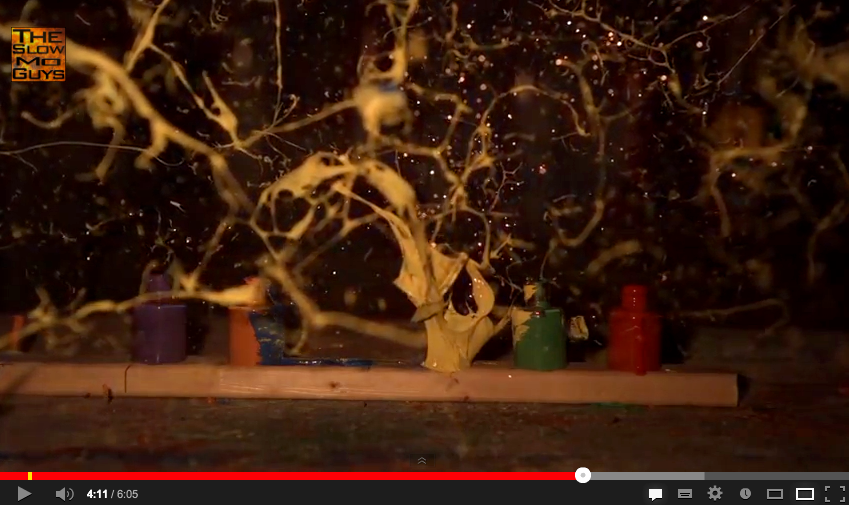
And then the slow-mo guys uploaded a video of paint exploding at 15000fps! Once paused the images give the same impression. Now imagine that as an object! A bit off track but scale it up a bit and have the lights pulse BOOM!


atmosphere atmosphere atmosphere atmosphere atmosphere atmosphere atmosphere atmosphere atmosphere

Real Quick Research

Weather Project, Olafur Eliasson, 2003
His site: olafureliasson
His pictures/video:

What a badass: "I'm just gonna put a sun in a room." (Please note that this was, to my knowledge, never said by Eliasson).

Nimbus, Berndnaut Smilde, 2010-2013

Site: berndnaut
Pics/Video:


More weather! In a smaller room!

Caleb Charland

Site: calebcharland
Stuff:
That is a lamp powered by apples. 
And a lamp powered by potatoes.
And citrus.

I didn't know how one would go about making a food powered lamp. I must have skipped that lession in year seven, however I did attend the week we were supposed to memorise the first 20 elements of the periodic table for a test. Hydrogen, Helium, Lithium, Beryllium....So I looked it up and thanks to Physlink I kinda understand the theory behind it:

Essentially "zinc and the copper are the anode and cathode terminals of your potato batter. Using ordinary hook-up electrical wire, you can use the potato to create a voltaic cell, which will power a VERY small bulb. A light emitting diode (LED) will work fine.

Cut the potato in half. Wrap the end of a piece of wire around a galvanised nail and wrap the end of a second piece of wire around a penny. Stick the copper side into one piece of potato the nail into the other. The zino and copper electrodes should not touch each other. If a wire is connected between the zinc nail and the copper penny, electrons will flow. However, direct contact of the two electrodes will only produce heat."

And then it goes into the chemical reactions which makes it happen. Link: physlink
This guy is a gun when it comes to explaining this:


And these guys are british: